Origin here is an argument, not a label. Rain, mist, altitude and the rock a
bush is standing in are what a leaf ends up tasting of, so on this map
climate 氣候 and terrain 地形 come
before the tasting note — and the tasting note is written as a consequence of
them, not as a separate opinion.
Six of the seven are in China. The seventh is 日本宇治,
and it is here on purpose.
Each marker is a button. Hover or tab to it, press Enter to open it, and the
map moves to that ground. The seven are listed beside the map as well, and
every word of the panel is in the page whether the drawing works or not.
×1
七大產地 · The seven
何時 · When each entered the record
Seven origins, one axis, 唐 Tang to now.
Most of what we drink is younger than it sounds.
七大產地,同一時間軸,自唐至今。多數名茶,其實遠比想像中年輕。
唐 Tang宋 Song元明 Ming清 Qing現代 Modern
雲南 Yunnan
潮州 Chaozhou
宇治 Uji
杭州 Hangzhou
武夷 Wuyi
安溪 Anxi
台灣 Taiwan
Documented 有據可考
Sources disagree 史料互異
Legend, not record 傳說,非史
Taiwan's high mountain oolong — the tea most people picture first — had
its first commercial harvest in 1986. Before 1980 that terrain was
thought too landslide-prone to plant. Uji's seven shogunal tea gardens
were laid out around 1400, and shading there is now verified by
soil dating to 1396–1440. Age and fame are not the same axis.
台灣高山烏龍首次商業採收於一九八六年;宇治七名園約成於一四〇〇年。名氣與年歲,並非同一回事。
普洱 Pu'er
雲南 Yunnan
湯色 Brewed liquor colour · #6f3826
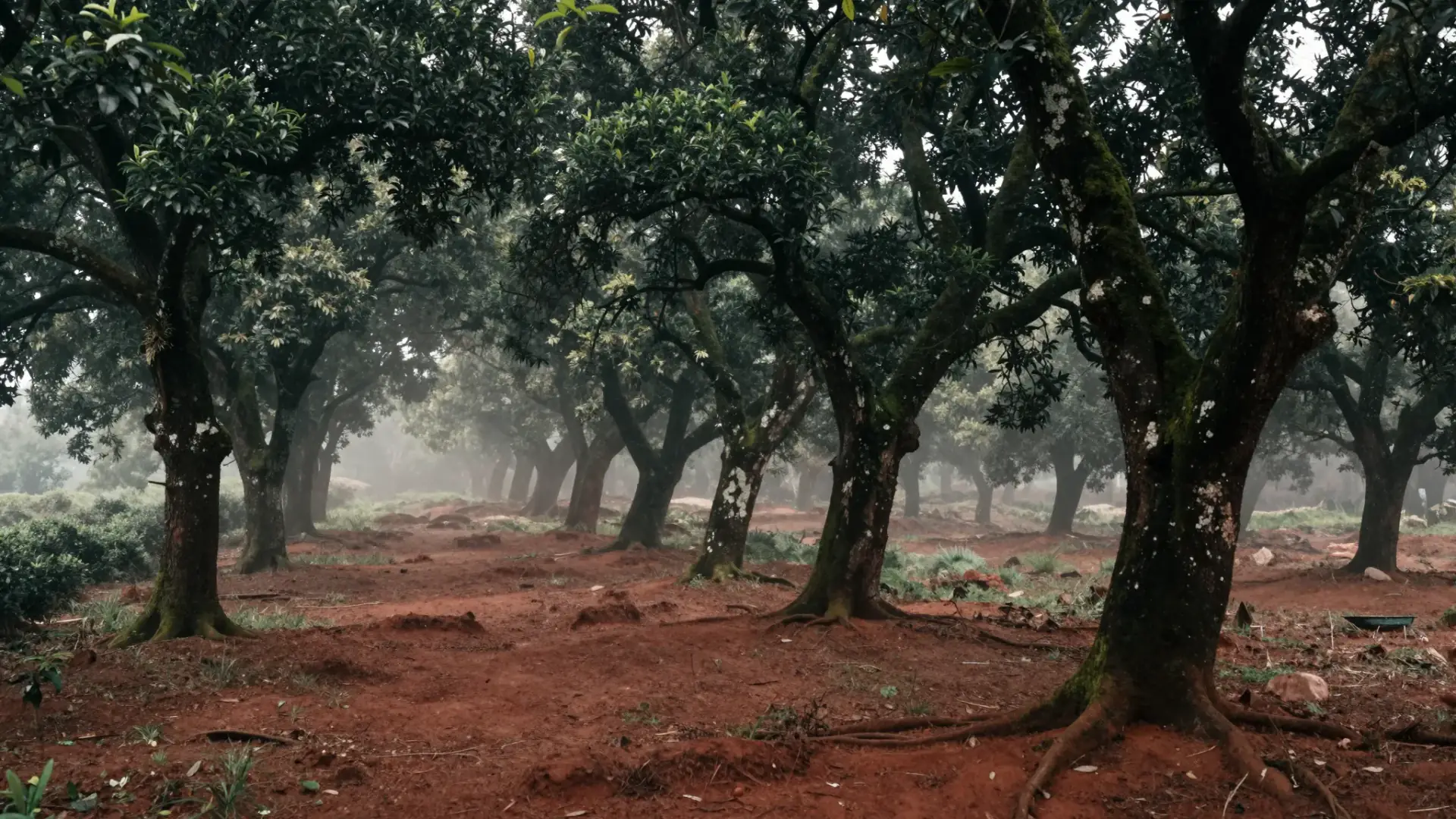
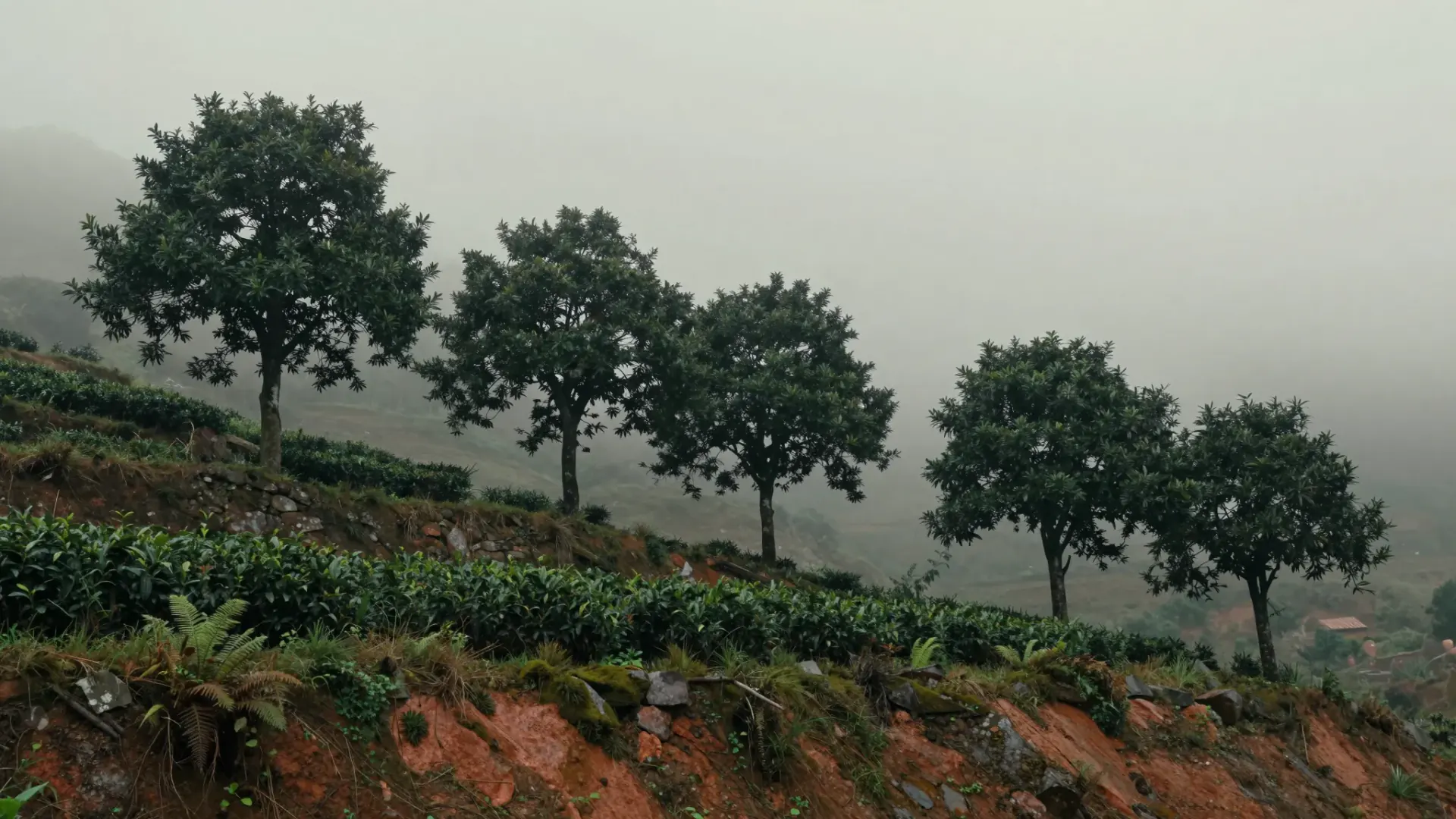
Illustration of the Yunnan tea forest — generated illustration, not a photograph of a named garden.
雲南茶山示意圖——生成之示意圖,非實地照片。
氣候 Climate
Warm monsoon rain and standing mist, under forest shade that never fully lifts.
季風暖雨,雲霧常駐,林蔭終日不散。
地形 Terrain
Red lateritic earth on slopes between 1,200 and 2,000 m, planted with large-leaf trees.
山坡紅壤,海拔一千二至二千公尺,所植為大葉種喬木。
風味 Taste
Earth, camphor and dark fruit, with a sweetness that arrives late and stays.
土香、樟香與深色果味,回甘來得遲,卻久留不去。
歷史 History
Compressed into cakes for the Tea Horse Road, where months on a mule to Tibet changed the tea on the way. Ripe pu'er, which compresses that change into weeks, was developed in Yunnan in the 1970s.
為茶馬古道緊壓成餅,馱行數月入藏,一路轉化。熟普以數週模擬此變,成於一九七〇年代的雲南。
儀式 Ritual
Rinse twice, pour fast, and stay at the table. This is a tea for the hours after a meal.
洗茶兩道,快速出湯,久坐不散。此茶宜於飯後長談。
本店 In the collection
普洱 Pu'er — Xishuangbanna, Lincang and Pu'er, from large-leaf trees rather than clipped bushes. Brewed at 100 °C, 7 g per 100 ml, 10 s first infusion, 12 infusions.
Continuously cultivated at Jingmai 景邁山 since at least the 10th century.
史事 What happened
In 1729 the Qing court carved out Pu'er Prefecture 普洱府 and brought the tea trade under direct rule, replacing hereditary chieftains with salaried officials and turning a hill-tribe product into a state-administered commodity moved north on the Tea Horse Road. Jingmai Mountain's tea forests, tended by the same communities for over a millennium, became China's first tea-related UNESCO World Heritage cultural landscape in September 2023.
Pu'er zones broadly, 800–2,000 m, on deep lateritic red soil, pH 4.5–6.5, under subtropical monsoon — broad-leaf var. assamica, much of it old unpruned arbor trees 古樹.
The dark ripe pu'er most drinkers know is not ancient. It was deliberately invented in 1973 at the state-run Kunming Tea Factory, using wet-piling 渥堆 to compress into 45–60 days a mellowing that raw pu'er 生茶 takes decades to reach.
今人熟知之熟普並非古法,乃一九七三年昆明茶廠以渥堆工藝所創,四十五至六十日即模擬生茶數十年之陳化。
傳說 The story, and what it is worth
Pu'er is often credited to Zhuge Liang 諸葛亮, venerated locally as tea god 茶祖. That is local veneration, not something the histories record.
民間奉諸葛亮為茶祖,屬地方信仰,非史書所載。
Sourced and confidence-rated in docs/briefs/tea-origins-research-2026-08-17.md. 出處與可信度分級見上述文件。
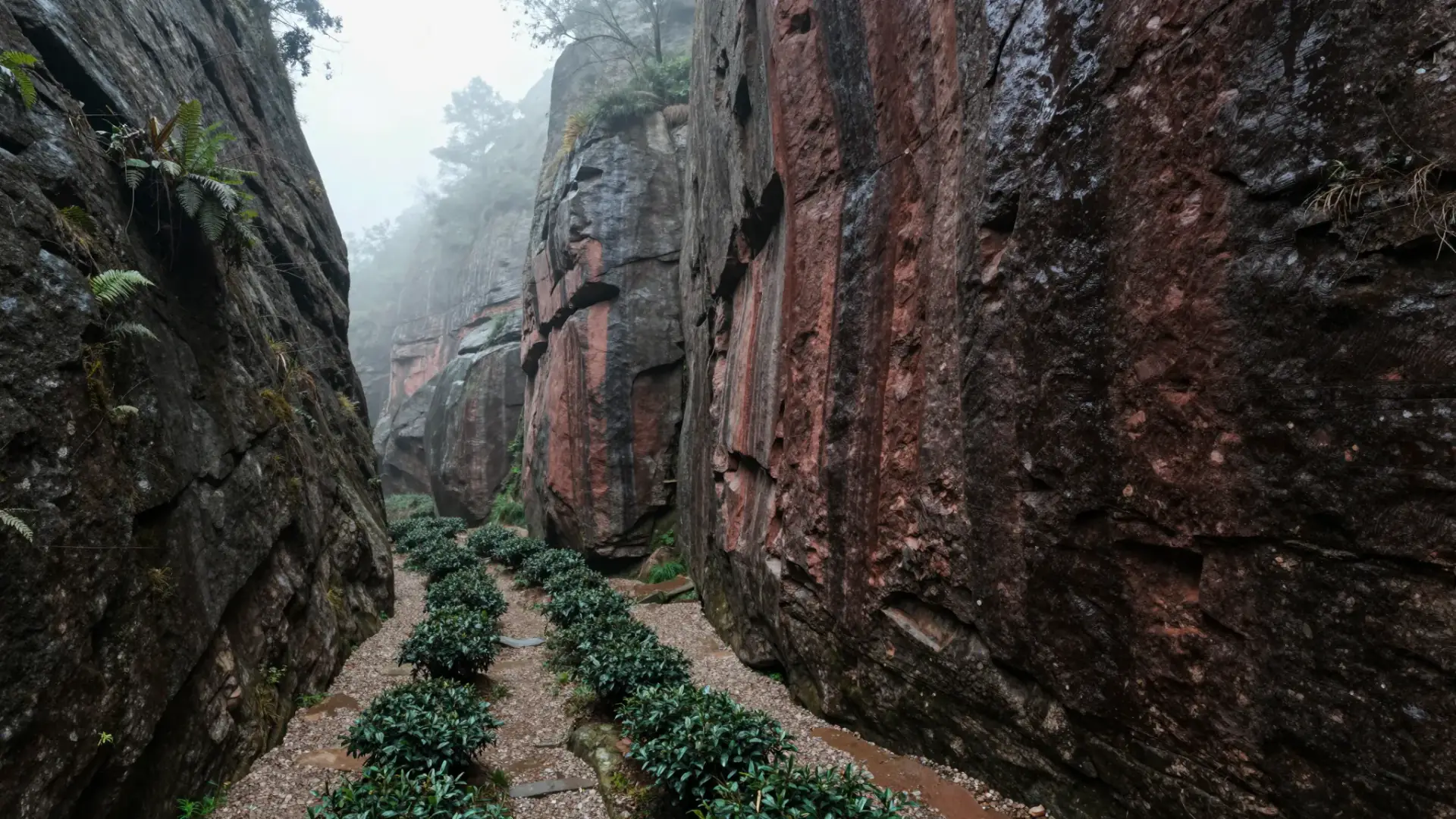
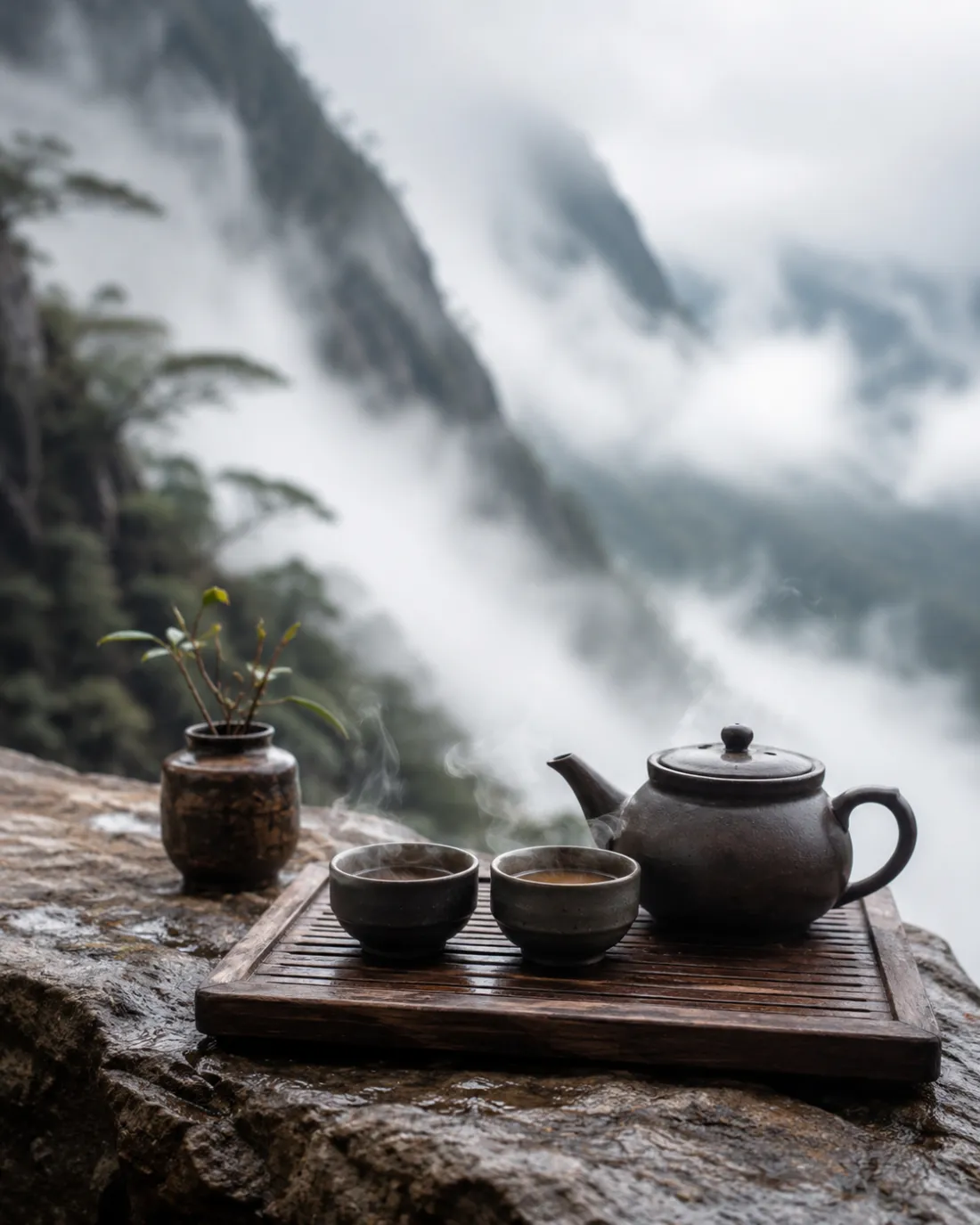
Illustration of a Wuyi rock ravine — generated illustration, not a photograph of a named garden.
武夷岩谷示意圖——生成之示意圖,非實地照片。
氣候 Climate
River mist trapped in narrow gorges, with cliff shade cutting the direct sun.
溪霧鎖於狹谷,岩壁遮陰,日照不直。
地形 Terrain
Weathered volcanic rock, with thin gritty soil in the cracks between cliffs. The bushes grow where there is barely ground.
風化火山岩,岩隙間僅存薄礫之土。茶樹生於幾無立足之地。
風味 Taste
Charcoal roast, orchid, and the mineral edge Wuyi calls yan yun — rock rhyme.
炭焙、蘭香,以及武夷所謂的「岩韻」——石之骨氣。
歷史 History
The Jian kilns that fired the Song dynasty's black tea bowls stood in the same Fujian prefecture as these cliffs. The roasting craft that now defines rock tea came later, under the Ming and Qing.
燒造宋代黑釉茶盞的建窯,與此地岩壁同屬福建一州。而奠定今日岩茶風骨的焙火之藝,則成於明清。
儀式 Ritual
Water at a full boil, a small clay pot, and infusions counted in seconds.
沸水、小壺,出湯以秒計。
本店 In the collection
大紅袍 Da Hong Pao
— cliff gardens above the Nine Bend River. Brewed at 100 °C, 7 g per 100 ml,
15 s first infusion, 8 infusions.
正山小種 Lapsang Souchong
— Tongmu 桐木, in the same massif.
Brewing figures: Requires verification.
Sources disagree on both the date and the mechanism.
史事 What happened
The six original Da Hong Pao 大紅袍 mother-tree bushes at Jiulongke 九龍窠 were commercially harvested for the last time in 2005. In 2006 the Wuyishan municipal government ended commercial harvesting outright, insured the six trees for RMB 100 million, and placed them under permanent protection. A 20 g portion of that final harvest sold at auction for RMB 208,000.
"True rock" 正岩 gardens sit in narrow, mist-trapped gorges cut into red Danxia sandstone — mineral-rich, free-draining, slightly acidic.
正岩茶園處於丹霞紅砂岩之狹谷,雲霧不散;礦物豐富,排水良好,微酸。
一事 One thing you would not know
No Da Hong Pao sold anywhere today, at any price, comes from the mother-tree bushes. All of it is cutting-propagated descendants — most often Qidan 奇丹, cloned from the mother trees in the 1980s–90s — or approximating blends.
The red-robe story — a scholar cured by monks' tea, an emperor's robe draped on the bushes in gratitude — exists in several mutually inconsistent versions, none of them dated, none in the record. A plainer reading is that "red robe" simply describes the reddish tint of spring leaf-tips in sunlight.
「紅袍」之說版本互異,皆無年代,亦無史據。另有一解:春芽日照下泛紅,故名。
注 Note
Rock rhyme 岩韻 is a tasting concept used in the trade, not a measured property of the leaf.
岩韻乃品飲之語,非可測之物性。
Sourced and confidence-rated in docs/briefs/tea-origins-research-2026-08-17.md. 出處與可信度分級見上述文件。
Qing origin is well established; the precise decade rests on a single textbook.
史事 What happened
Wang Fuli's 茶說 (Cha Shuo, c. 1708–1720, Kangxi era) already documents sun-withering, bruising 搖青, fixation and roasting — steps close to modern oolong processing. Whatever the founding story, the method was mature in this region by the early 18th century.
Tie Guan Yin is a cultivar品種 — the Hong Xin 紅心 bush — propagated only by cutting, never by seed. Effectively every true Tie Guan Yin plant in the world descends clonally from a small Anxi mother stock.
Two competing origin legends, and the sources that carry them flag both as unverifiable. In the Wei version 魏說, the farmer Wei Yin is led by Guanyin in a dream to a shoot in a rock crevice. In the Wang version 王說, the scholar-official Wang Shirang finds a bush near Guanyin Rock and presents it to the Qianlong Emperor, who names it. No court record of that presentation has surfaced.
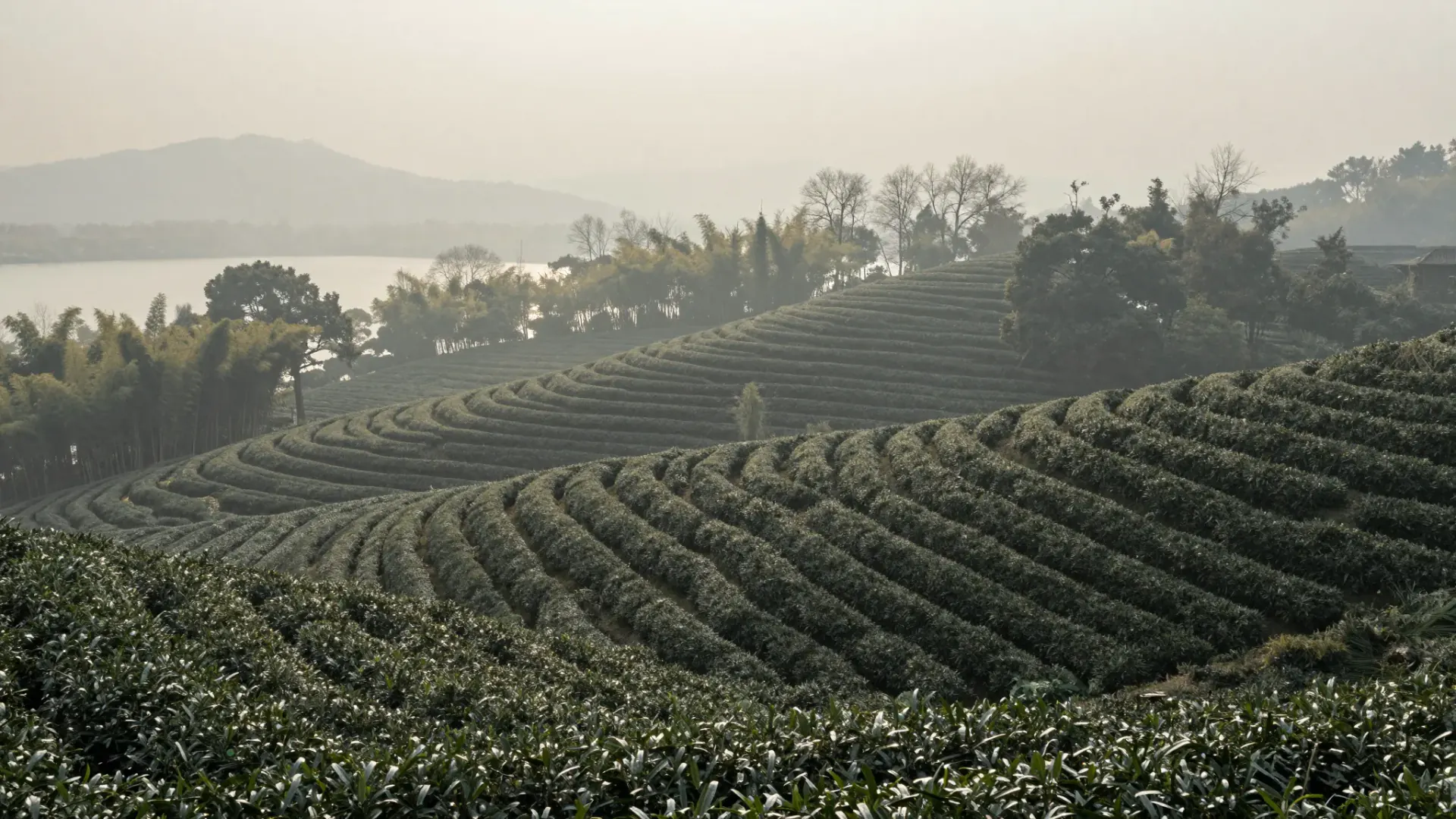
Illustration of the West Lake hills — generated illustration, not a photograph of a named garden.
西湖茶丘示意圖——生成之示意圖,非實地照片。
氣候 Climate
Mild lake air and spring rain, with a picking window that closes within days.
湖畔氣候溫潤,春雨綿密,採摘之期不過數日。
地形 Terrain
South-facing slopes around West Lake, sheltered by Lion Peak.
西湖周邊南向緩坡,獅峰為之屏障。
風味 Taste
Toasted chestnut, sweet pea and clean spring grass.
炒栗香、豆香,兼春草之清。
歷史 History
The Qianlong Emperor is said to have set eighteen bushes at Hu Gong Temple aside as imperial. Leaf picked before the Qingming festival is still the most sought-after of the year.
相傳乾隆帝於胡公廟前圈定十八棵御茶。明前所採,至今仍為一年中最受追求者。
儀式 Ritual
A tall glass, water at 80 °C poured down the side, and the patience to watch flat leaves stand upright before they sink.
直筒玻璃杯,八十度水沿杯壁注入,靜觀扁葉先立而後沉。
本店 In the collection
龍井 Longjing — the villages under Lion Peak. Brewed at 80 °C, 2 g per 100 ml, 45 s first infusion, 3 infusions.
The Jiajing-era (r. 1521–1567) Zhejiang gazetteer 浙江通志 records that among Hangzhou's teas none compared to Longjing's — the earliest solid textual attestation of Longjing as a distinct product. The Ming scholar Tian Yiheng 田藝蘅 praised it by name in 煮泉小品.
Low hills around West Lake at about 30°N: 2,000–3,000 mm of rain, 80–90% humidity, weak solar radiation and frequent mist — conditions that raise amino acids and lower polyphenols, which is where the low bitterness comes from.
Longjing is entirely pan-fired by hand in a bare wok, using ten named hand movements — 抓、抖、搭、拓、按、推、扣、甩、磨、壓. No machine reproduces it. In March 2012 top pre-Qingming West Lake Longjing was reported selling above the price of gold by weight.
The story that the Qianlong Emperor personally designated eighteen imperial tea bushes 十八棵御茶樹 at Hu Gong Temple is told as legend even by the sources that repeat it.
乾隆於胡公廟前欽點十八棵御茶樹之說,連轉述之來源亦稱其為傳說。
Sourced and confidence-rated in docs/briefs/tea-origins-research-2026-08-17.md. 出處與可信度分級見上述文件。
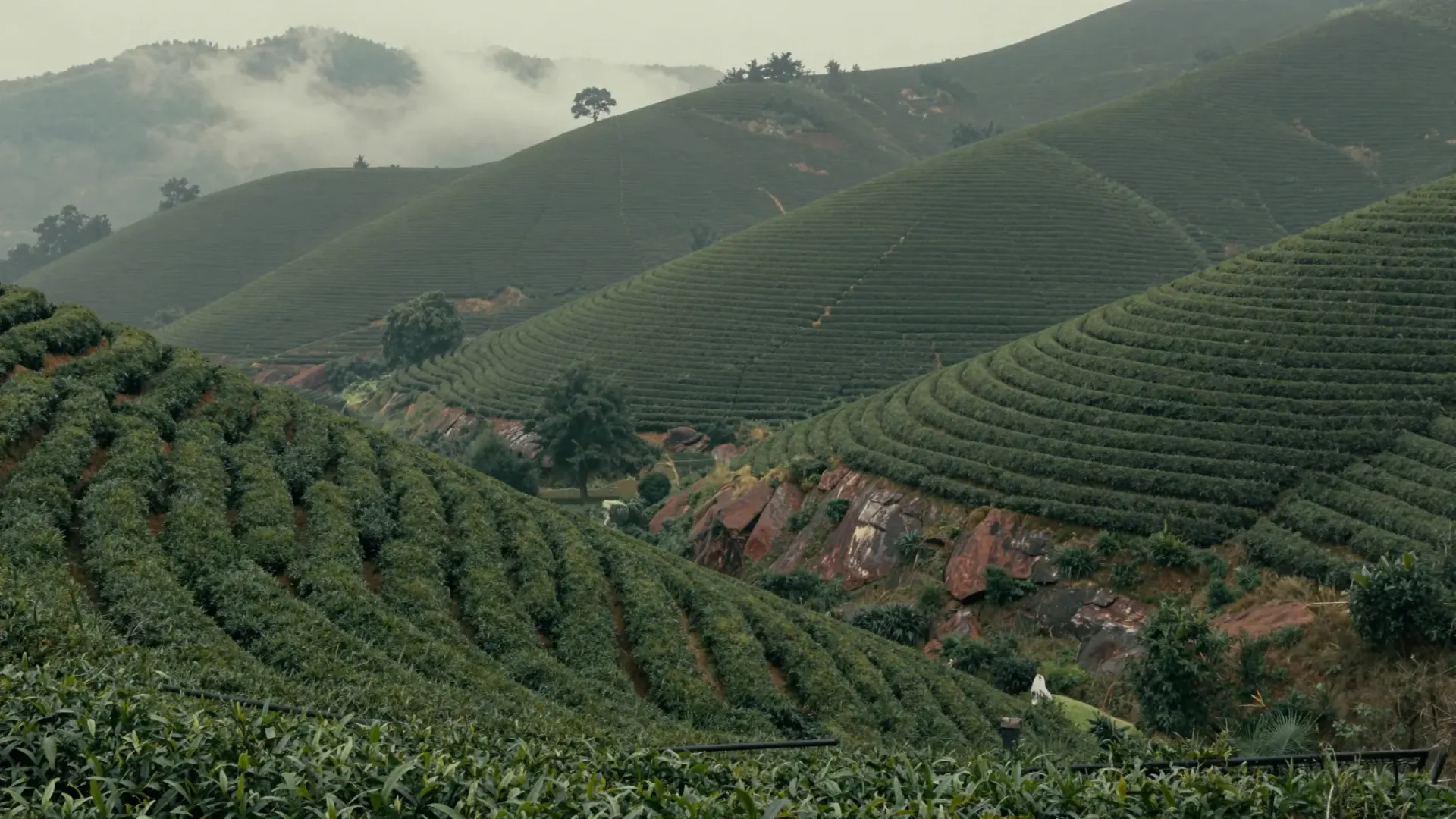
Illustration of Phoenix Mountain — generated illustration, not a photograph of a named garden.
鳳凰山示意圖——生成之示意圖,非實地照片。
氣候 Climate
Warm coastal air rising to meet the cloud on Phoenix Mountain.
海濱暖風上迎鳳凰山之雲。
地形 Terrain
Phoenix Mountain ridges to 1,400 m, where single old trees are picked and made separately.
鳳凰山脈,高及一千四百公尺,單株老樹各自採製。
風味 Taste
Honey orchid, stone fruit, and a bright bitterness that folds into sweetness.
蜜蘭香、核果香,苦意鮮明而終化為甘。
歷史 History
Dancong means single bush: one tree harvested and processed on its own. The fragrance types — honey orchid, almond, ginger flower — are named for what the tree gives.
「單叢」者,單株成茶:一樹自採自製。其香型——蜜蘭、杏仁、薑花——皆以樹之所出而名。
儀式 Ritual
Chaozhou gongfu: a small pot filled generously, water at a rolling boil, and pours short enough that the bitterness never has time to arrive.
潮州工夫茶:小壺滿投,滾水沖之,出湯極快,苦味來不及生。
本店 In the collection
No tea in the Chazen collection is currently sourced from Chaozhou.
朝代與源流 Dynasty & origin南宋末 · 約一二七八 · Late Southern Song · c. 1278Legend, not record 傳說,非史
The founding event is tradition, not documented history.
史事 What happened
Local tradition holds that the fleeing child-emperor Zhao Bing 趙昺 passed through Wudong 烏崠 on Phoenix Mountain in 1278–79, that attendants picked wild leaves for him, and that the tree was afterwards called Song tea 宋茶, its descendants Song Zhong 宋種. Better attested is the technique itself: dancong 單叢 means a single bush plucked and processed alone, never blended — which is what actually makes this tea what it is.
Wudong gardens sit at roughly 900–1,100 m on the Fenghuang massif, whose highest point reaches 1,497.8 m — red-yellow granitic soil, mean temperature about 17.4 °C, mist-shrouded, high-rainfall subtropical monsoon.
The Song Zhong tree most closely tied to the legend collapsed and died in August 2016, from age together with ice and frost damage. Every Song Zhong sold today comes from cutting-propagated descendants. Sources disagreeCorroborated across tea-trade sources; no independent news or academic report located.
與傳說關聯最深之宋種母樹,於二〇一六年八月因樹齡與冰凍霜害倒伏枯死。今日所售宋種,皆為扦插後代。
Sourced and confidence-rated in docs/briefs/tea-origins-research-2026-08-17.md. 出處與可信度分級見上述文件。
從此地而來 What comes from here
Nothing in the collection is sourced from Chaozhou yet. The tea atlas covers Phoenix Mountain and its single-bush Dancong in full. 本店目前未有潮州茶品。鳳凰山與單叢之說,詳見茶類地圖。
高山烏龍 High Mountain Oolong
台灣 Taiwan
湯色 Brewed liquor colour · #d7c36c
氣候 Climate
Cold highland fog and a large day-to-night temperature swing that slows the leaf.
高山冷霧,日夜溫差極大,茶芽因而生長遲緩。
地形 Terrain
Gardens above 1,000 m on the central ranges — Alishan, Shanlinxi, Lishan.
中部山脈海拔千米以上之茶園——阿里山、杉林溪、梨山。
風味 Taste
Cream, alpine flower and sugarcane, thick in the mouth and almost without bitterness.
奶香、高山花香與蔗甜,湯感厚實,幾無苦澀。
歷史 History
Taiwan's oolong craft arrived with Fujian settlers in the nineteenth century. The high mountain gardens that now define it were planted from the 1980s.
台灣烏龍之藝,隨十九世紀福建移民而來。今日所稱高山茶園,則自一九八〇年代始闢。
儀式 Ritual
A porcelain gaiwan adds nothing of its own. Give the rolled pearls a long first infusion and follow the fragrance as it opens.
白瓷蓋碗不奪茶味。球形茶首泡宜久,隨其香氣層層舒展。
本店 In the collection
高山烏龍 High Mountain Oolong — Alishan, Shanlinxi and Lishan, above 1,000 m. Brewed at 95 °C, 6 g per 100 ml, 45 s first infusion, 7 infusions.
朝代與源流 Dynasty & origin一九八〇年代 · The 1980sDocumented 有據可考
Not the Qing — that is a different tea. See below.
史事 What happened
In 1980 a fruit grower at Lishan 梨山 planted oolong seedlings at about 2,500 m as an experiment, and Taiwan's first commercial high-mountain harvest followed in 1986. Before that, this terrain was considered too landslide-prone to plant at all. The Taiwan Tea Research and Extension Station drove the wider shift through the decade.
Above 1,000 m — commonly 1,000–2,600 m — on steep slopes with large day-to-night temperature swings and frequent cloud cover diffusing the light, which slows leaf growth and concentrates aromatics while reducing bitterness against lowland oolong.
The high-mountain boom carries a documented environmental cost. Because these gardens sit on erosion-prone terrain, often encroaching on national forest and watershed reserve, the government has actively dismantled and reforested plantings — notably removing tea gardens at Dayuling 大禹嶺 from national forest land in 2014–15 for watershed protection.
Do not conflate two eras. Tea cultivation in Taiwan does date to the Qing 清, with Fujianese settlers bringing seedlings north around 1796–1820 and oolong export taking off in the 1860s–80s. High mountain oolong is a separate, much later thing.
Humid river-basin air, with the last weeks before harvest spent under shade cloth.
河谷濕潤,採摘前數週覆蓋遮光。
地形 Terrain
Flat alluvial fields along the Uji river, south of Kyoto.
京都以南,宇治川流域的沖積平地。
風味 Taste
Umami and sweet cream over a soft vegetal bitterness that clears quickly.
鮮味與乳甜之下,帶一層柔和的青苦,散得很快。
歷史 History
Uji has grown tea since the thirteenth century, from seed brought back from Song China by Buddhist monks. Its stone mills still grind shaded leaf into powder.
宇治自十三世紀得宋地茶種而植茶,其種由僧侶渡海攜歸。至今仍以石磨將覆下茶葉碾為細末。
儀式 Ritual
Sift the powder, whisk with water off the boil until the foam stands, and drink from the bowl without pouring — the tea and the vessel are a single act.
先篩茶末,以略降溫之熱水擊拂至湯花挺立,就碗而飲,不另分茶——茶與器本為一事。
附註 Why it is here
Uji is on this map for a reason. Japanese matcha is the Song dynasty's whisked tea, carried across the sea by monks and kept alive there after China itself moved on to steeped loose leaf under the Ming.
For Uji's documented rise. Tea's arrival in the region is told as legend.
史事 What happened
The shogun Ashikaga Yoshimitsu 足利義満 (1358–1408) ordered seven tea gardens opened at Uji — the 宇治七名園 — making it the shogunate's premier source. The shading that defines matcha-grade tea (覆下栽培, producing tencha 碾茶) was long dated to the late 16th century from a Jesuit account, until a 2019 radiocarbon and phytolith soil study at the Okunoyama garden pushed verifiable shading back to layers dated 1396–1440.
A low river valley south of Kyoto on the Uji-gawa: warm and humid, with sharp day-to-night swings that raise morning river fog. The fog acts as natural partial shade — the same logic the artificial shading later industrialised.
Under the Tokugawa, an annual ceremonial procession — the ochatsubo dōchū 御茶壺道中 — travelled from Edo to Uji for the sole purpose of fetching the shogun's tea. At its peak it numbered over 1,000 people escorting more than 100 tea jars, and held such precedence on the road that ordinary travellers, samurai included, had to stop and stay indoors as it passed.
One thing this page will not claim: that Uji matcha descends unbroken from Song whisked tea. The transfer is documented — Song China had a whisked powdered-tea culture 點茶, and Japanese monks brought the preparation back in the late 12th century. But the Chinese tradition did not continue: the Hongwu Emperor's 1391 edict abolished compressed tribute tea in favour of loose leaf, and whisked tea had effectively died out in China by about 1400. Japan preserved and then independently developed it. Continuity of technique, not of lineage.
Ground decides what the leaf could become. The workshop decides what it
does become — and the difference between the families is not a secret
ingredient but which of these steps are used, in which order, and where
殺青 falls in the sequence.
黃茶另有「悶黃」,花茶另有窨製,二者皆不在此七道之列。
Yellow adds 悶黃 and scented adds 窨製 — neither is one of the seven, which is
why both trace the green route here and part from it elsewhere.
一
採摘 Plucking
What is taken — bud alone, bud and one leaf, or a coarser pick — sets the ceiling for everything that follows. Every family begins here, and no later step can add back what was not picked.
二
萎凋 Withering
The picked leaf loses water and goes limp, so it can be handled without shattering. It is also where oxidation quietly begins, which is why white tea — withered and nothing else — never sits at zero.
三
殺青 Fixing
Kill-green. Heat from a wok, a rotating drum or steam denatures the enzymes and stops oxidation where it stands. Its position in the sequence is the single largest fork in tea.
四
揉捻 Rolling
The leaf is rolled, twisted or balled so its cells break and its shape is set. Broken cells release juices, which speeds oxidation where oxidation is still running, and makes the liquor come out faster in the cup.
五
發酵 Oxidation
Enzymes turn the leaf brown, as a cut apple does. Held for a short while it gives flowers and fruit; run to the end it gives malt, cocoa and dried fruit. Chinese calls it fermentation; chemically it is oxidation.
六
乾燥 Drying
The last water out, over charcoal, in an oven or in the sun. In black tea the firing is also what finally halts oxidation; in rock tea repeated charcoal roasting is a flavour step in its own right.
七
渥堆 Wet piling
Dark tea only. Dried leaf is wetted, heaped and turned so microbes work on it — fermentation in the literal sense, not oxidation, and the reason ripe pu'er tastes of damp wood rather than of green leaf.
Fixing comes early, often within hours of picking, so oxidation never gets a chance to start. That is why green tea keeps the fresh, grassy, chestnut character of the raw leaf.
白茶 White
Pick → Wither (long) → Dry · 採摘 → 萎凋(長)→ 乾燥
No fixing and no rolling at all — the least handled tea there is. A little oxidation happens during the long wither anyway, which gives the hay and melon character without any of the briskness rolling would bring.
Green tea's sequence with one addition: after fixing, the warm damp leaf is wrapped and left to yellow. The step is slow and easy to ruin, and what it buys is the removal of the grassy edge.
烏龍 Oolong
Pick → Wither → Shake, bruising the edges (partial oxidation) → Fix → Roll → Dry or roast · 採摘 → 萎凋 → 做青(部分氧化)→ 殺青 → 揉捻 → 乾燥/焙火
Fixing lands in the middle rather than at either end, so the maker chooses where to stop. Shaking bruises the leaf edges while the centre stays green — which is exactly why an oolong can carry flower and roast at once.
There is no fixing step at all. Rolling comes before oxidation instead of after it, so the broken leaf browns all the way through, and the final firing is what stops it. Hence malt, cocoa and a red liquor.
黑茶 Dark
Pick → Wither → Fix → Roll → Dry → then piled wet, or pressed and aged · 採摘 → 萎凋 → 殺青 → 揉捻 → 乾燥 →(渥堆 或 壓餅陳放)
Fixed and dried like a green tea first, then handed to microbes — piled wet for the ripe style, or pressed and left for years for the raw one. It is the only family that keeps changing after it leaves the workshop.
These sequences are the conventional teaching outlines. Real workshops vary
them, split steps, repeat them, and disagree about the boundaries — no step
order here is a specification for any particular lot, and no timing or
temperature is stated except where it appears in a tea's own brewing note.
The map is stylised and drawn by hand for reading, not for navigation:
positions are approximate and boundaries are not a statement about any
border. Everything on this page is geography, process and flavour. Chazen
makes no medical or therapeutic claim for any tea, and no price or grade is
stated here.